
What does it take to bring groups alive online?
(it's about avoiding the Triangle of Zoom Doom.)


There is something particularly absurd to find yourself listening to someone talk about relational practice while sitting in a Teams webinar where you cannot see or communicate with anyone.
Ewan McIntosh recently posted about the dangers of being average. “…where the gravitational pull in strategy meetings seems to be reductive, rather than expansive, desperately attempting to head towards the apparent safe ground of average.” What would it take for us to be ‘excellent’ rather than average? Alternatively, what does it take for groups to come alive?

[from] The Trees Witness Everything by Victoria Chang, published by Copper Canyon Press, 2022.
Isn’t that like us?
When Johnnie, Viv and I ran an online series during COVID times, we noticed the following trances, and nicknamed by Mary, one of our participants as the triangle of Zoom Doom. These are traps that show up in face-to-face events just as readily as online ones.
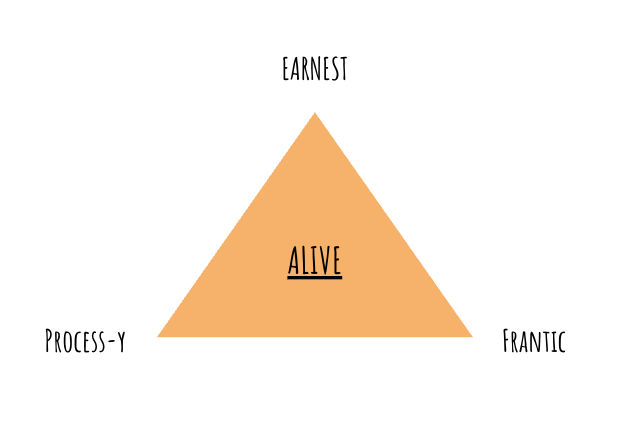
The Process-y Trance is when you let your process or tech get in the way of conversation. Like when you obsess about some technical glitch and leave people waiting while you flail about, instead of creating a bypass. Or when sticking to a predetermined process misses an important topic of discussion.
The Frantic Trance is when you mistake busyness for engagement. Like when your icebreaker runs too long, or when you rush from one activity to the next.
The Earnest Trance is when everyone’s being polite because you are talking about a VIT - Very Important Topic - and in reality they are bored or disengaged.
Chances are, any online meeting will slide to one point or other on the triangle. Once you notice this, you have a chance to change something. The challenge is to stay alive to what you are doing as a facilitator, and to keep the event alive for your participants.